
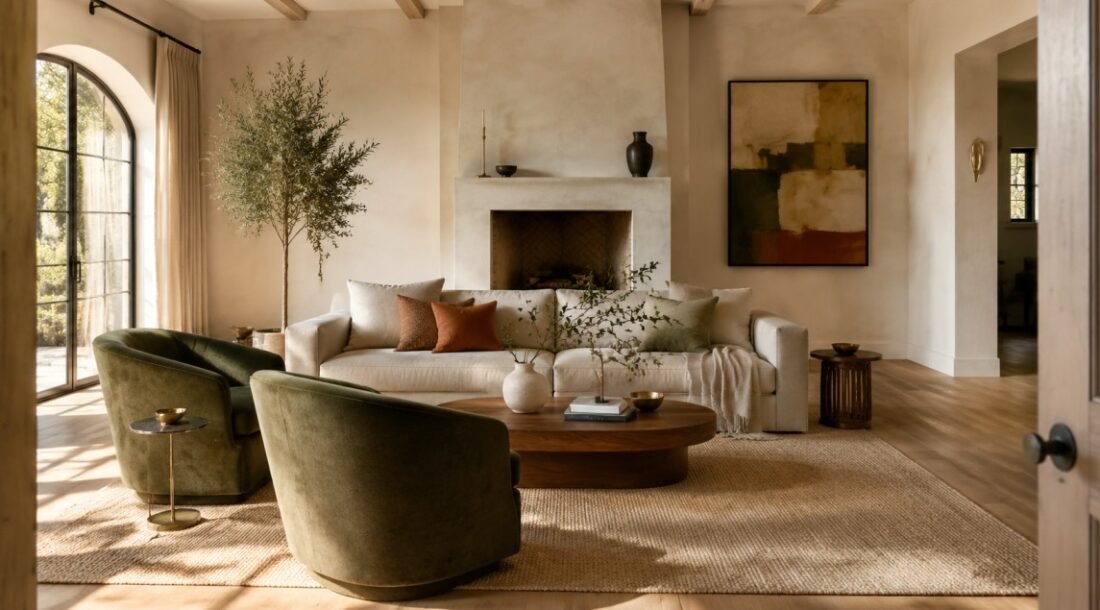
A well-decorated living room does more than look attractive in photographs. It supports conversation, provides comfortable places to sit, handles everyday clutter and still feels like it belongs to the people who live there. Getting all of those elements to work together is easier when you decorate in a deliberate order.
The most effective approach is to begin with function and layout—not cushions, artwork or a fashionable paint color. Once the room’s practical foundation is settled, you can choose a palette, place the main furniture, build a lighting plan and gradually add character. This order also helps prevent expensive mistakes, such as buying a sofa that overwhelms the room or choosing a rug that looks disconnected from the seating area.
This guide explains how to decorate a living room from start to finish, including useful measurements, small-space alternatives, renter-friendly ideas and a final editing process that keeps the result comfortable rather than overstyled.
Table of Contents
Start With the Way Your Living Room Needs to Work
The first step in decorating a living room is to decide how it will be used, measure the available space and create a basic furniture plan. Establishing these practical details before shopping helps you choose pieces that fit both the room and your routine.
A formal sitting room used mainly for conversation requires a different arrangement from a family space that handles television, homework, toys and frequent guests. Write down the room’s two or three most important functions. If watching television is the priority, comfortable sightlines will influence the sofa position. If you host friends regularly, movable stools or lightweight occasional chairs may be more useful than one oversized sectional.
Next, measure the room’s length and width, followed by the locations of doors, windows, radiators, vents, electrical outlets and architectural features. Record the usable wall space between openings. A sofa may technically fit along a wall but still interfere with a doorway or leave no suitable position for a side table.
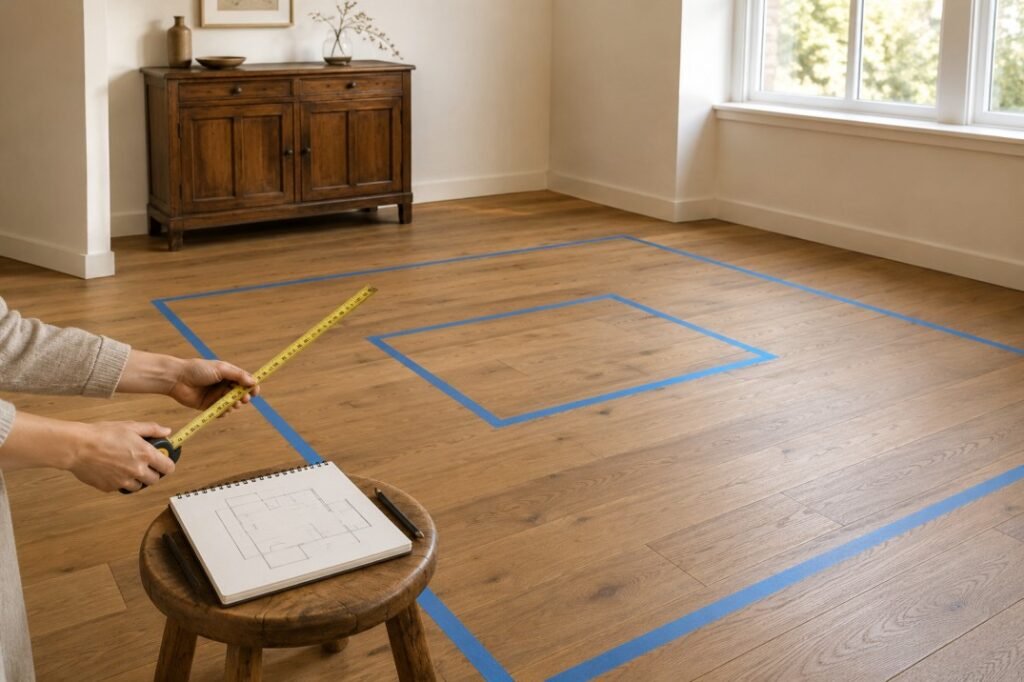
Use painter’s tape to mark the footprint of potential furniture on the floor. This simple test reveals how a piece will affect circulation more clearly than dimensions on a product page. Walk through the taped arrangement, open nearby doors and imagine carrying a laundry basket or serving tray through the space.
As useful starting points, try to preserve approximately 30 to 36 inches for major walkways and around 14 to 18 inches between a sofa and coffee table. These are practical guidelines rather than fixed rules. A compact apartment may require tighter spacing, while a large open room can accommodate more generous circulation.
Account for What the Room Already Has
Identify the elements you intend to keep, including flooring, curtains, built-in storage and existing furniture. These pieces will influence later color and material choices. It is usually more realistic to design around an expensive charcoal sofa or warm wood floor than to pretend it is not part of the palette.
Also note the room’s daylight. A north-facing or shaded room may benefit from warmer colors and reflective surfaces, while a bright room can often handle deeper or cooler tones without feeling gloomy.
Choose a Color Palette and Style Direction
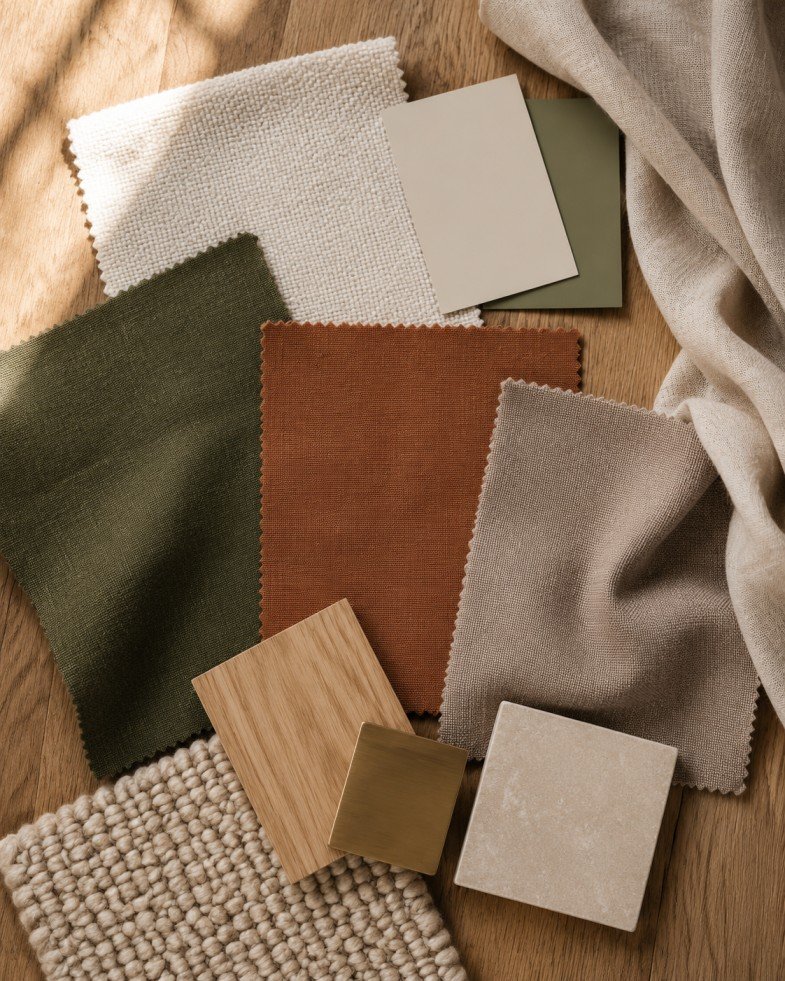
A useful living room palette usually begins with the room’s fixed features. Look at the undertones in the flooring, stonework, largest furniture pieces and wood finishes. Warm oak, for example, often sits comfortably with cream, clay, olive, muted blue and other softened colors. Cool gray flooring may work better with chalky white, charcoal, dusty blue or restrained green.
Choose one main neutral or background color, one supporting color and one or two accents. The familiar 60-30-10 approach can be a helpful reference—roughly 60 percent dominant color, 30 percent supporting color and 10 percent accent—but it should not become a strict mathematical exercise. What matters is that colors repeat often enough to appear intentional.
Before committing to paint, observe large samples at different times of day. A beige that feels calm in morning light can appear yellow under a warm evening bulb. Place samples next to the flooring, sofa fabric and curtains rather than judging them in isolation.
Your style direction can be equally simple. Instead of forcing the room into a narrow label, collect a handful of reference images and identify the recurring qualities. You may consistently prefer low furniture, warm woods, quiet colors and handcrafted ceramics. Those shared characteristics offer better shopping guidance than a vague instruction to make the room “modern.”
For a restrained result, combine pieces through repeated materials or shapes. A curved chair can relate to a round side table, while black picture frames might repeat the finish of a floor lamp. Matching every item exactly tends to make a living room feel purchased as a set rather than assembled over time.
Renters can develop a palette through removable elements: curtains, rugs, cushions, lampshades, artwork and slipcovers. Paint is useful, but it is not the only way to give a room a coherent identity.
Plan the Furniture Layout Around an Anchor
Begin the furniture layout with the largest or most important piece. In many living rooms, that will be the sofa. In others, it may be a sectional, fireplace, window view or pair of chairs inherited from family.
Placing all furniture against the walls is not automatically wrong, particularly in a narrow room. However, pulling the seating inward by even a few inches can create a more connected arrangement when space allows. In a larger room, floating the sofa can define the living area and leave space behind it for a console, reading corner or walkway.
Arrange seats so people can speak without turning awkwardly. A sofa facing two chairs often feels more conversational than every seat pointing toward a television. Where television viewing matters, place the screen where glare is manageable and include at least one chair that can turn toward either the television or the conversation area.
Give the Room a Clear Focal Point
A focal point provides a visual resting place. It might be a fireplace, artwork, a view, a bookcase or a media unit. Rooms can contain more than one point of interest, but they should not compete equally.
If a fireplace and television share the same room, decide which one should dominate. Keeping the media furniture visually quiet, limiting accessories and using related colors can reduce competition. When the room has no architectural feature, a substantial artwork, gallery arrangement or well-proportioned shelving unit can create focus without major construction.
Adapt the Layout for a Small Living Room
Compact rooms benefit from furniture that provides visual breathing space. Sofas with visible legs, open-sided tables and wall-mounted lighting expose more floor and can make the arrangement feel less crowded. This does not mean every item must be miniature. One properly scaled sofa is often more useful—and visually calmer—than several undersized chairs. For a deeper room-by-room approach, see our small living room decorating guide.
Choose multifunctional pieces selectively. A storage ottoman can replace a coffee table, while a small stool may serve as a side table or extra seat. Avoid filling every corner simply because a narrow piece will fit there. Some empty space is part of a successful layout.
Get the Scale of Rugs and Tables Right
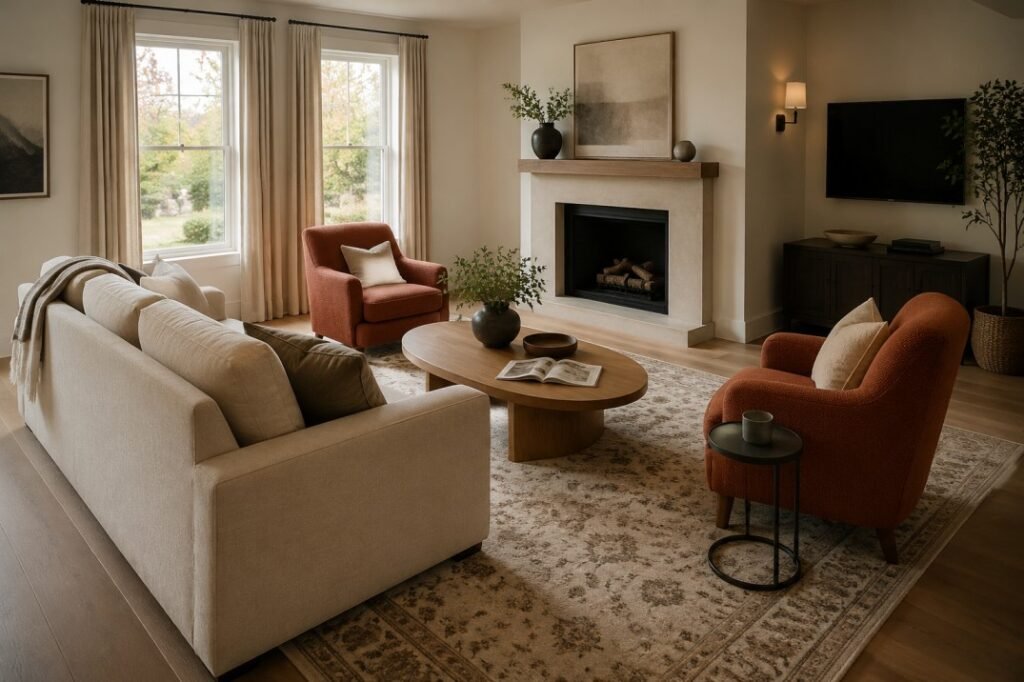
A rug should visually connect the seating group rather than appear as an isolated rectangle in the center. In many arrangements, a rug large enough to sit beneath the front legs of the sofa and chairs creates a unified look. A room-size rug can accommodate all furniture legs, while a smaller rug is more convincing when used intentionally beneath a compact coffee table or layered over a larger plain rug.
Use the rug sizing guide for sofas and sectionals to narrow down the options. Before choosing a size, mark the rug’s proposed edges with painter’s tape. Check that the border around it relates sensibly to the walls and that nearby doors can open freely. If the ideal size exceeds the budget, consider a simple natural-fiber base rug with a smaller patterned rug layered on top.
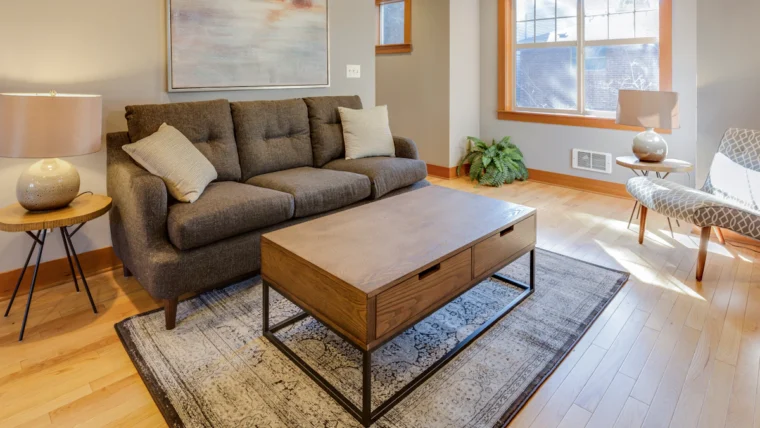
The coffee table should relate to both the sofa and the available walkway. A table approximately two-thirds the visual length of the sofa often looks balanced, although arm shape and surrounding furniture can change that relationship. Round or oval tables soften rooms dominated by rectangular furniture and remove sharp corners from tight circulation routes.
Side tables do not need to match, but their surfaces should be convenient to reach from the seats they serve. Consider the height of the sofa arms and chair seats before buying. A beautiful table that is uncomfortably low for a drink will quickly become decorative rather than useful.
Layer Lighting, Window Treatments and Wall Decor
A single ceiling fixture rarely provides enough flexibility for a living room. A more comfortable plan combines ambient lighting for the entire room, task lighting for activities and accent lighting that highlights a wall, shelf or architectural feature.
Start with the lights needed for real tasks. Place a floor lamp near a reading chair and a table lamp where someone might work, read or play a game. Then use ambient sources such as a ceiling fixture or shaded lamps to soften the room. A picture light or small directional lamp can add focus, but accent lighting should support the arrangement rather than illuminate every decorative object.
Use similar color temperatures across fixtures so the room does not feel visually disjointed. Dimmers are helpful where installation is practical, while smart bulbs or plug-in dimmer options may offer greater flexibility to renters. Confirm that any bulb or dimmer is compatible with its fixture before use.
Window treatments affect both atmosphere and proportion. Hanging curtains above the window frame and allowing them to extend beyond its sides can make the opening feel more generous. The panels should still be full enough to look intentional when closed. Where privacy is important, combine curtains with a shade instead of relying on thin decorative panels.
Treat wall decor as part of the furniture arrangement. Artwork above a sofa should relate to the sofa’s width rather than float as a small object on a large wall. A gallery wall benefits from consistent spacing or a repeated element, such as frame color. Lay the arrangement on the floor first or test paper templates on the wall—especially useful in a rental where unnecessary holes should be avoided.
Add Texture, Storage and Personal Details
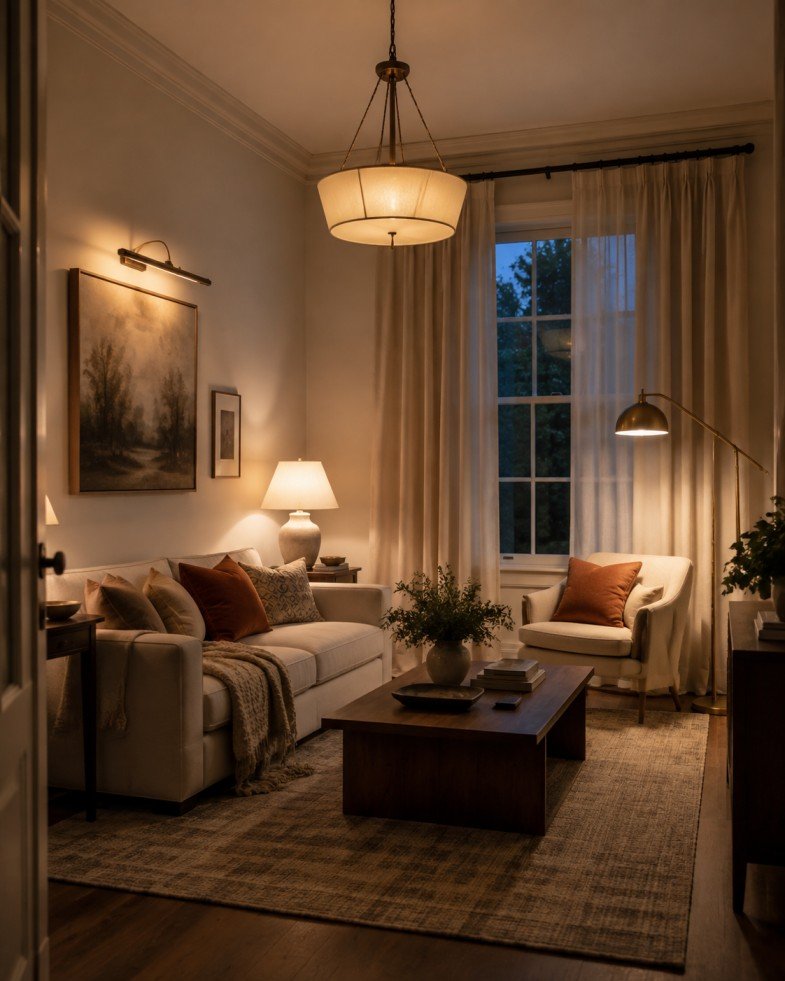
Once the larger decisions are settled, introduce softness and character through cushions, throws, books, ceramics and natural materials. Work with texture as well as color: linen beside velvet, smooth wood next to woven fibers or glazed pottery against a matte wall creates depth without requiring a busy pattern.
Start with fewer cushions than you think you need. Add them gradually, mixing sizes or shapes while repeating at least one color from the larger palette. Seating should remain usable; guests should not have to remove a pile of pillows before sitting down.
Storage is most successful when it matches the type of clutter the room produces. A lidded basket may handle blankets, while a closed cabinet is better for electronics, games or paperwork. Open shelving works well for objects worth displaying, but it can become visually tiring when used as overflow storage. If you are working with a compact home, the same principle appears in our small kitchen organization guide: store items near the task they support and reserve open storage for things worth seeing.
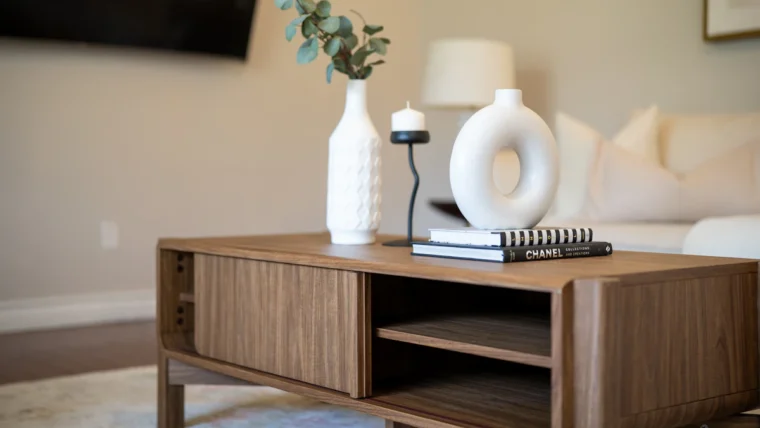
Style the coffee table with a small group of items at varied heights while preserving room for daily use. A tray, a low bowl, one or two books and a modest natural element may be enough. Avoid spreading tiny accessories evenly across every surface. Grouped objects create clearer visual pauses and are easier to move when the table is needed.
Personal items are what keep a polished room from feeling anonymous. Frame a meaningful print, display books you actually read or incorporate an older piece with visible history. The goal is not to prove that every corner has been decorated. It is to make the room recognizable as yours.
Edit the Room Before Calling It Finished
A living room often becomes clearer after you stop adding things. Photograph it from the doorway and from the main seating position. A photograph can reveal awkward gaps, crowded surfaces or uneven visual weight that are easy to overlook in person.
Live with the major arrangement for several days before making final purchases. Notice where people naturally set down drinks, which seats are used and whether anyone has to move around furniture awkwardly. That information may show that the room needs another table or lamp—not another decorative accessory.
Common finishing mistakes include:
- Choosing every item from one matching collection
- Using a rug that does not connect the seating
- Depending on one overhead light
- Hanging small artwork too high on a large wall
- Blocking walkways with occasional furniture
- Adding accessories before solving storage
- Following a trend that conflicts with the room’s practical needs
When the budget is limited, prioritize the pieces that affect comfort and scale: seating, lighting and the rug. Curtains, artwork and decorative objects can be added slowly. A room assembled over time often feels more personal than one completed in a single shopping trip.
Frequently Asked Questions
Conclusion
Decorating a living room successfully is less about finding a perfect set of furnishings and more about making a sequence of sensible decisions. Start with the room’s purpose, measure carefully and establish a comfortable layout. From there, develop a palette, choose correctly scaled pieces, layer the lighting and introduce texture, storage and personal objects.
Give the room time before treating it as complete. Everyday use will reveal what is missing, what feels awkward and which details genuinely improve the space. The result should not merely look arranged; it should make sitting, talking, reading and relaxing feel natural. For more practical inspiration, continue exploring EmberDecorIdeas’ Living Room Ideas collection as you develop your own room plan.

4 Comments