
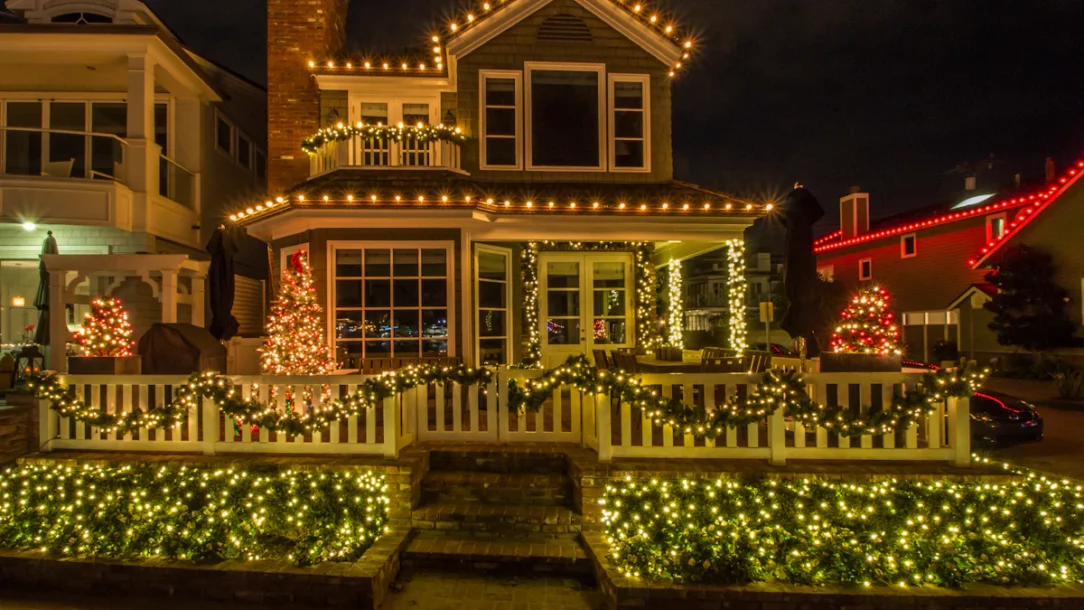
Outdoor Christmas decorations look best when the house feels intentionally dressed rather than covered in every holiday item collected over the years. A cohesive display has a clear lighting color, repeated materials, one or two strong focal points, and enough empty space for the architecture to remain visible.
The second half of a good exterior display is less glamorous but just as important: weather, power, fastening, walkways, and storage. Decorations have to survive rain, wind, snow, and temperature swings without creating electrical or trip hazards. This guide combines both sides so the final result looks polished and works safely through the season.
Table of Contents
Plan the Display From the Street Before You Hang Anything
Start outside at the curb or the normal approach to the house. Identify the three elements people notice first: usually the roofline, front door, and one tree or landscape feature. Those should carry most of the visual weight.
Do not begin by decorating each surface independently. A porch railing, garage, tree, columns, windows, and front walk can all look good on their own yet compete when seen together. Sketch the display as one composition and decide which areas will stay intentionally quiet.
If the front entry is already narrow, use the same circulation-first approach from the fall front porch guide: the door and walkway remain functional first, then the seasonal layers fit around them.
Choose One Color and Lighting Language
A cohesive outdoor display usually has one dominant lighting color and one supporting accent palette. Warm white or champagne lights with evergreen, red, burgundy, natural brown, and brass-toned details create a classic look. Warm white with black, cream, and deep green feels more restrained and architectural.
Current 2026 outdoor holiday styling is leaning strongly toward warm white, champagne, natural greenery, and selective architectural lighting instead of outlining every available edge. One current trend report also notes the move toward accenting key architecture rather than treating the house as a continuous light grid. See the 2026 outdoor lighting trend overview.
You can still use multicolor lights if that suits the home. The important part is consistency: repeat the same color family at the roofline, porch, and landscape rather than mixing warm white in one area, cool white in another, and saturated color somewhere else. If you want the exterior palette to connect more deliberately with the rooms inside, use the flow principles in this whole-home color palette guide.
Make the Front Door the Main Focal Point
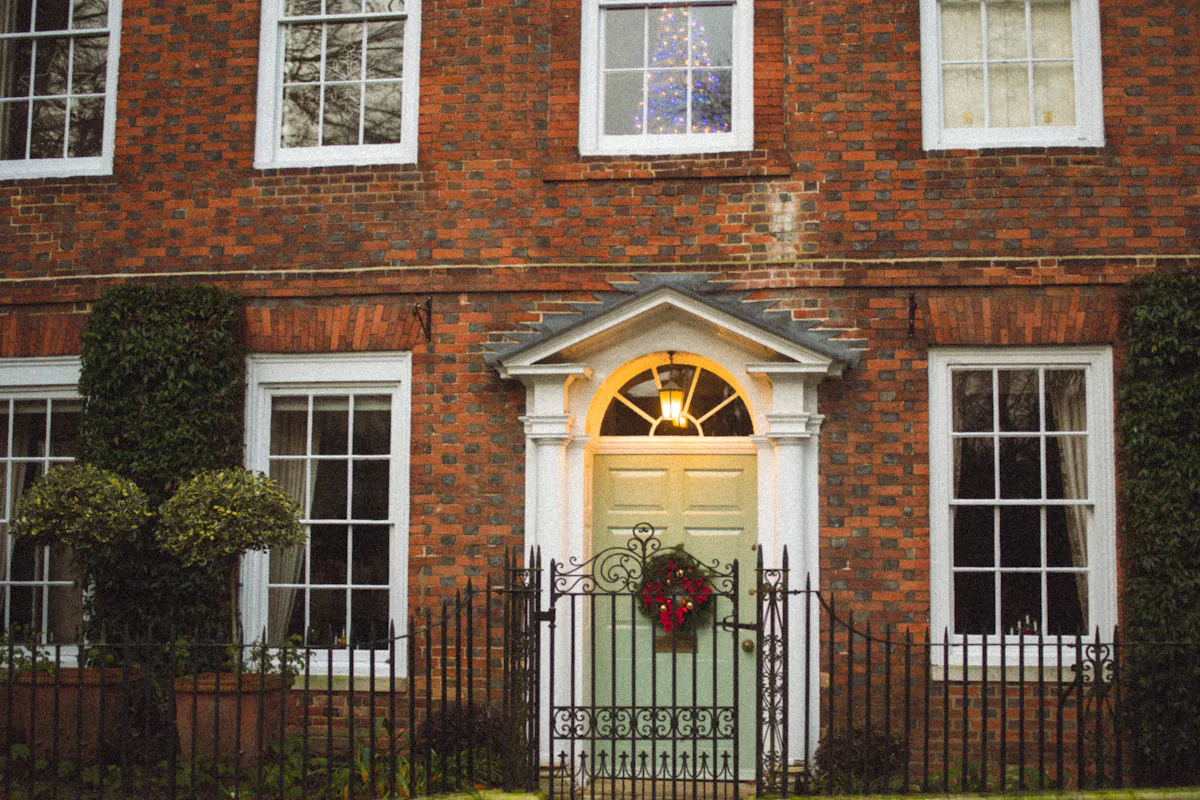
The front door is the natural place for the strongest decorative moment because it is already where the eye wants to land. Use a wreath, door swag, garland, or one oversized bow, then repeat one material from that focal point elsewhere.
If the wreath uses cedar, pinecones, red berries, and burgundy ribbon, let the porch planters or railing garland repeat two of those ingredients. You do not need an identical set; repetition is enough to create cohesion.
Keep hardware usable and the door swing clear. Oversized wreaths, long ribbon tails, and loose garlands should not cover the handle, smart lock, doorbell, or house number.
Use Roofline Lights as Structure, Not Visual Noise
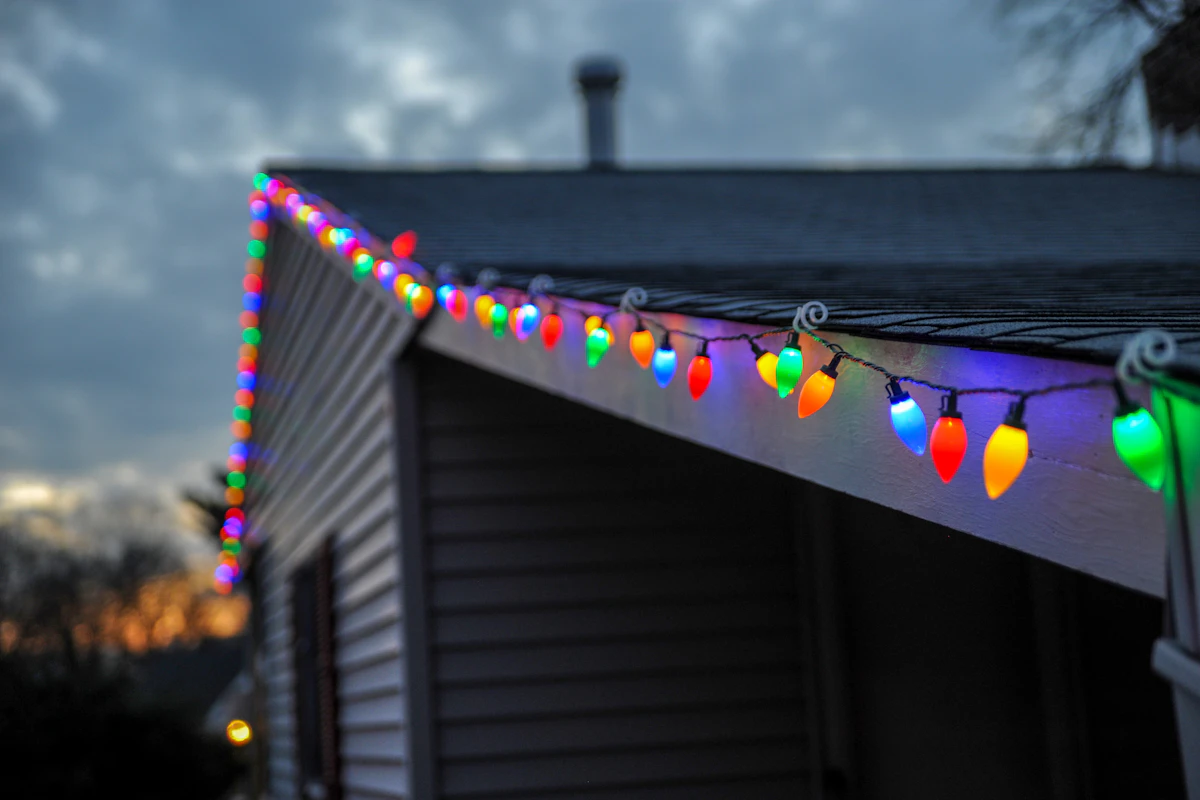
Roofline lighting can outline the shape of the house and create the visual framework for everything below. Keep bulb color, spacing, and direction consistent so the line looks intentional from a distance.
On many homes, you do not need to trace every gable, dormer, gutter, window, and garage opening. Choose the main roof edge or one architectural feature, then let the porch and landscape supply the secondary layers.
Use clips and attachment methods designed for the specific light product and mounting surface. Avoid nails, tacks, or improvised fasteners that can damage wires. CPSC guidance specifically recommends securing outdoor lights to firm supports and using suitable hooks or insulated fasteners rather than damaging the cord. Review CPSC holiday-light safety guidance.
Repeat Greenery to Connect the Porch, Railings, and Windows
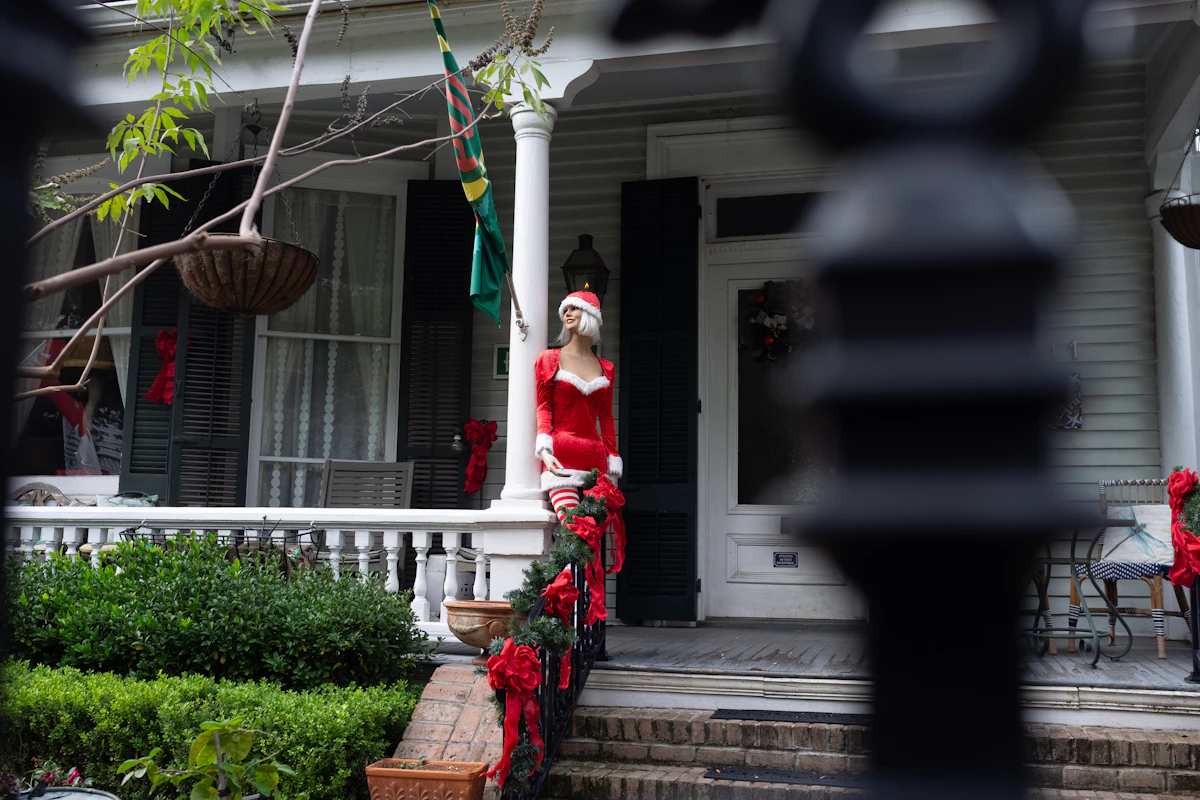
Greenery is one of the easiest ways to connect different parts of the exterior without adding another light color. Use the same general foliage language—cedar, pine, fir, eucalyptus, or a realistic mixed garland—around the door and in one or two secondary places.
Avoid wrapping every railing, column, window, and fence in thick garland. One substantial entry garland plus a lighter echo on the railing or window boxes usually reads as more deliberate.
If the greenery is artificial, confirm it is suitable for outdoor use. If it is fresh, expect color and needle retention to vary with temperature, sun, and exposure; keep it away from electrical connections and heat sources.
Build Weather-Smart Outdoor Christmas Planters
Planters are useful because they create height, volume, and seasonal texture in one contained footprint. Reuse existing urns or pots and build the arrangement with an upright center, a fuller middle layer, and greenery that softens the rim.
Birch stems, sturdy branches, evergreen boughs, pinecones, berries, and weather-resistant ornaments can all work. Push the heaviest materials deep into the container and follow the product or nursery guidance for securing anything tall or wind-exposed.
Use the same ribbon, berry color, or greenery type that appears at the front door so the planter feels like part of the same display. One substantial planter can look more finished than several small seasonal objects spread across the porch.

Use Yard Decorations Sparingly and Repeat Shapes
Inflatables, light-up figures, wire-frame deer, stars, and oversized ornaments can all work, but choose one family rather than one of everything. Two or three related forms create a scene; unrelated pieces create visual noise.
Place yard elements where they support the house rather than hide it. A pair of lit deer near a tree, several oversized stars near the porch, or one restrained group of glowing spheres can provide depth without becoming a separate attraction from the architecture.
Light Trees and Shrubs Selectively
Landscape lighting can extend the display beyond the house, but it is most effective when one or two plants become focal points. Wrap the trunk and lower branches of a feature tree, or use net lights on a limited shrub group rather than lighting every plant in the yard.
Keep the light temperature consistent with the house. Warm white roofline lights paired with icy blue landscape lights will make the display feel split unless that contrast is intentional.
Do not install lights where branches will pull hard on wires in the wind. Follow the light manufacturer’s placement instructions and recheck the installation after severe weather.
Make the Power Plan Before the Decor Plan Gets Too Big
Count the powered elements before installation: roofline strings, garland lights, planters, yard figures, and tree lights. Then identify where the outdoor receptacles are and which items can reach them without cords crossing steps or walkways.
CPSC advises using outdoor lights that are certified for outdoor use, inspecting for cracked sockets, frayed or bare wires, and loose connections, and using extension cords rated for the intended use. Outdoor decorations should be connected to a GFCI-protected receptacle or portable GFCI. See CPSC’s holiday decorating safety guide.
Do not solve a poor power plan by daisy-chaining extension cords or power strips. If the display requires more power or better outlet placement than the exterior safely provides, simplify the display or have a qualified electrician address the permanent electrical setup.
Choose Outdoor-Rated Materials and Fasten Them for Weather
“Outdoor” should describe more than the location. Lights, extension cords, timers, electrical connections, and powered decorations need ratings suitable for outdoor conditions. Decorative fabrics, ribbons, wreaths, and ornaments should also be chosen for the amount of rain, snow, sun, and wind the site actually receives.
Use manufacturer-approved stakes, clips, ties, and anchors. Keep lightweight decor away from open corners and roof edges where wind accelerates. After a storm, check cords, clips, stakes, garlands, and freestanding pieces before turning everything back on.
Weather-smart design is also an editing tool: fewer, better-secured pieces usually look more polished and require less maintenance than a yard filled with lightweight objects.
Keep Steps, Walkways, and Doors Clear
No Christmas display should make the route to the front door harder to use. Keep extension cords, stakes, planter bases, gift-box props, and light-up figures outside the normal walking line. Leave enough open landing space to unlock and open the door comfortably.
The same rule applies to garage walkways, side gates, and any path used for trash bins or deliveries. A beautiful display that forces people onto wet grass or icy edges is not a successful layout.
If your entry tends to get crowded during seasonal decorating, use the clear-path principles in these small-entryway ideas as a useful planning mindset even though the post focuses on interiors.
Use Timers and LEDs for a Cleaner Nighttime Display
Timers or smart outdoor plugs can keep the display consistent from night to night and prevent lights from staying on unnecessarily. Set the display to come on near dusk and turn off at a reasonable hour for the household and neighborhood.
LED lighting is especially useful for holiday displays because it uses much less energy than older incandescent technology and produces less wasted heat. ENERGY STAR notes that LEDs can use up to about 90% less energy than incandescent lighting. See ENERGY STAR’s LED overview.
Keep any smart plug or timer within its outdoor-use rating and installation instructions. A device being “smart” does not automatically make it weatherproof.
For a Small House or Porch, Use a Three-Layer Formula
A compact exterior does not need fewer ideas; it needs stronger editing. Use three layers: one architectural light layer, one greenery layer, and one focal accent. That might mean warm roofline lights, a door garland, and two matching planters.
If there is no roofline access, shift the lighting layer to the porch or one small tree. The formula stays the same even when the specific objects change.
The restrained color and texture approach from the warm, natural fall decor guide transitions well into Christmas: keep the base materials consistent, then swap autumn accents for evergreen, ribbon, lights, and winter branches.
For a Larger Exterior, Create Zones Instead of Decorating Everything
A large house can handle more decoration, but scale does not require covering every surface. Break the property into zones: house architecture, entry, one landscape feature, and perhaps a driveway or gate. Give each zone a purpose and connect them with the same lights or accent color.
For example, the roofline might carry warm white lights, the porch might carry greenery and burgundy ribbon, and one large tree might repeat the same lights. The garage can stay mostly quiet except for matching wreaths. The negative space is what keeps the larger display from becoming visually flat.
Design the Display for Easy Takedown and Storage
Weather-smart decorating continues after Christmas. Label light strings by location as they come down, coil extension cords loosely, dry damp greenery or fabric before storage, and keep clips and stakes with the items they belong to.
Photograph the finished exterior before removing anything. Next year, that image becomes a layout map and makes it easier to recreate the successful parts without starting from scratch.
If a decoration was constantly falling, tangling, or collecting water, do not automatically store it for another season. Replace or redesign the problem area while the experience is still fresh.
Common Outdoor Christmas Decorating Mistakes
Mixing several unrelated light colors. A display can use color, but the palette should repeat intentionally.
Decorating every architectural edge. Selective lighting usually gives the house more depth than tracing every line.
Adding decor before planning power. Cord routes and outlet capacity should be solved before the installation grows.
Using indoor-rated lights or cords outside. Exterior conditions require products specifically approved for outdoor use.
Letting the porch become storage for decorations. The front door still needs a clear landing and walking path.
Ignoring wind exposure. Lightweight bows, wreaths, inflatables, and garlands need appropriate fastening and regular checks.
Frequently Asked Questions
How do I make outdoor Christmas decorations look cohesive?
Choose one main light color, repeat two or three materials or colors, and let one area lead visually. For example, use warm white lights, evergreen greenery, red ribbon, and black planters from the front door to the roofline instead of mixing unrelated themes.
What outdoor Christmas lights are safest to use?
Use lights specifically labeled for outdoor use and tested by a nationally recognized testing laboratory. Inspect cords, sockets, and connections for damage before installation, and plug outdoor decorations into GFCI-protected receptacles.
How can I decorate outside for Christmas without overdoing it?
Start with three layers: one architectural light layer, one greenery layer, and one focal accent such as a wreath or planter. Add more only where the exterior still feels visually empty after those are in place.
Can I use indoor extension cords for outdoor Christmas lights?
No. Use extension cords rated for outdoor use and for the electrical load you are connecting. Keep connections protected from moisture and follow the light and cord manufacturers’ instructions.
What color Christmas lights look most elegant outdoors?
Warm white, champagne, and soft gold lights usually create the most cohesive understated look. Classic red-and-warm-white can also feel polished when repeated consistently across the display.
How do I keep outdoor Christmas decorations from blowing away?
Use the fastening system recommended by the manufacturer, secure lightweight decor to stable structures, keep large pieces out of exposed wind tunnels, and check the display after storms or strong winds. Avoid improvised fasteners that can damage wiring or the house.
A Cohesive Christmas Exterior Is More About Repetition Than Quantity
The strongest outdoor Christmas decorations share a visual language from the curb to the front door. Repeat one light color, one greenery style, and a small accent palette, then let the architecture decide where the display gets louder and where it stays quiet.
At the same time, treat weather and electricity as part of the design. Outdoor-rated products, secure fastening, GFCI protection, clear walkways, and a realistic power plan are what allow the display to keep looking good after the first rain, wind, or snow. When the styling and the practical plan support each other, the exterior feels polished instead of temporary.


Share Your Thoughts