
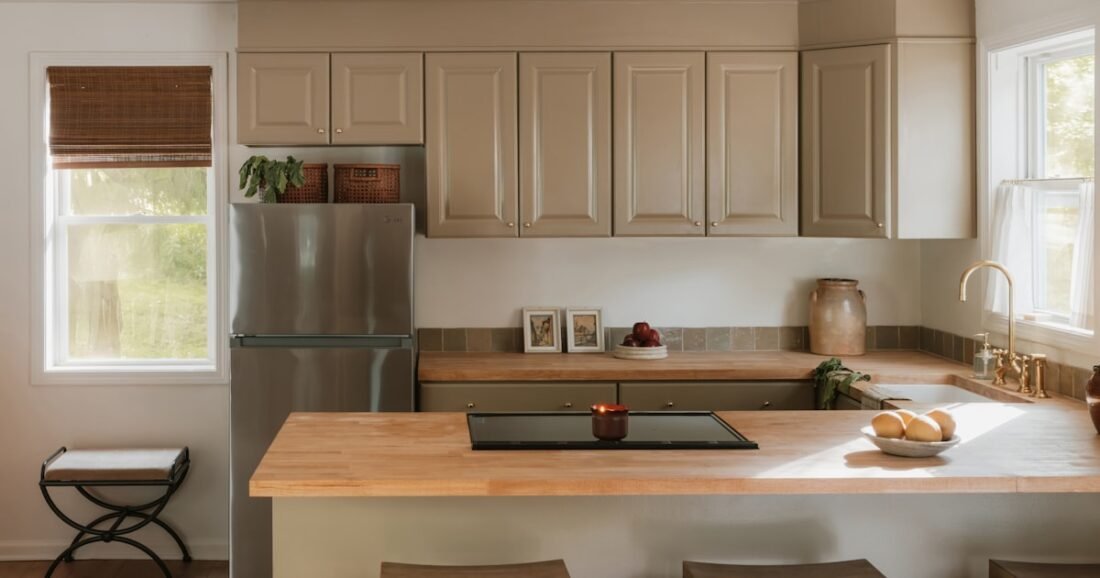
A small kitchen can feel noticeably larger without moving a wall. The biggest improvements usually come from making the room easier for the eye to read: clearer counters, better lighting, fewer competing finishes, and stronger visual continuity between cabinets, walls, backsplash, flooring, and decor.
The goal is not to strip the kitchen of personality. It is to make every visible element earn its place. When storage handles the everyday clutter and the main surfaces relate to one another, even a narrow galley or compact apartment kitchen can feel calmer, brighter, and more comfortable.
Table of Contents
Start With the Visual Clutter You Already Have
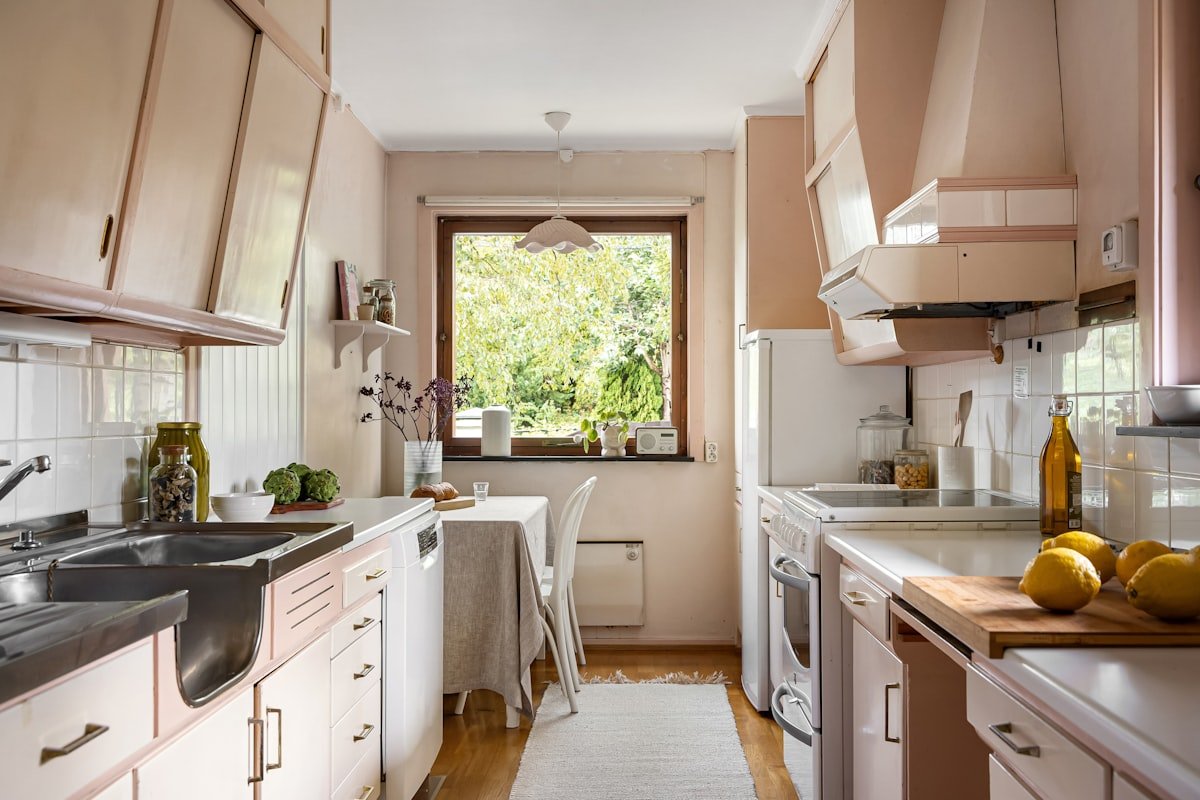
Before repainting cabinets or buying new accessories, stand at the kitchen entrance and notice what stops your eye first. In a compact room, visual noise often comes from appliances spread across the counters, a refrigerator covered edge to edge, open shelves packed tightly, several metal finishes, or a strong backsplash competing with equally strong cabinets and flooring.
Clear one uninterrupted section of counter before you do anything else. Keep out only the appliances you use frequently, group cooking essentials on one tray, and move duplicate or rarely used items into storage. A room with fewer visible interruptions usually feels larger even before the color scheme changes.
If storage is the reason the counters stay crowded, our small kitchen organization guide focuses on cabinets, drawers, pantry zones, and daily reset routines.
Use Light Colors, but Prioritize Continuity
Light colors can help a kitchen feel airy, but painting everything bright white is not the only solution. Continuity is usually more important. When cabinets, walls, countertops, and backsplash sit in a related range, the room reads as fewer large planes rather than many separate blocks.
Warm white, pale greige, soft mushroom, muted sage, light taupe, and gentle blue-gray can all work in a small kitchen. Start with the fixed elements you are not changing—flooring, counters, appliances, or cabinet color—and choose the surrounding finishes from there.
If you prefer stronger color, place it where it has a clear role. Darker lower cabinets with lighter uppers can ground the room without making the entire wall feel heavy. A painted island can carry a deeper color while the perimeter stays quieter. For help matching undertones, see our guide to warm versus cool neutrals.
Control Contrast Between Large Surfaces
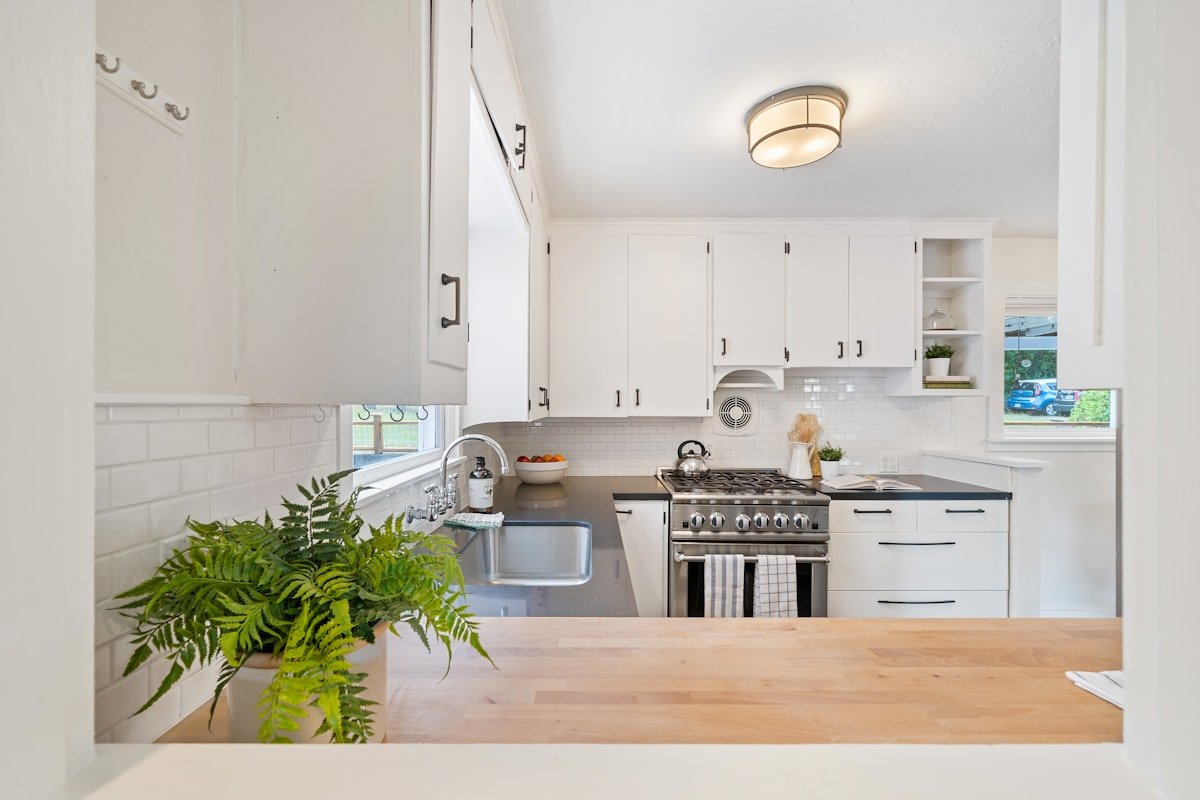
High contrast makes edges easier to notice. That can be beautiful, but in a very small kitchen it can also emphasize every boundary. If the cabinets are already dark, a quieter backsplash and counter can create balance. If the floor has a strong pattern, keep the walls and large vertical surfaces calmer.
You do not need to eliminate contrast. Concentrate it in a few deliberate places instead: one pendant, dark hardware, a narrow runner, a framed print, or a set of stools. When every major surface competes for attention, the kitchen feels busier than its size alone would suggest.
Improve Lighting Before Changing the Decor
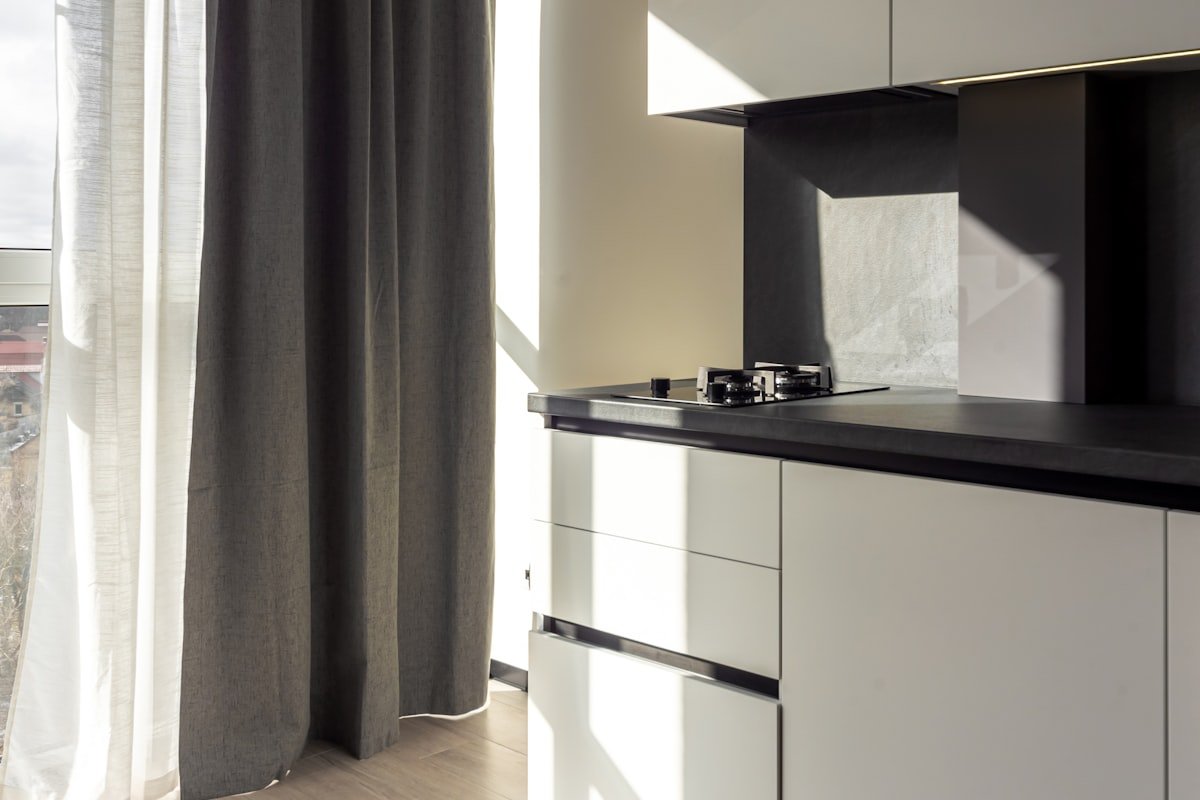
Shadows under upper cabinets, around corners, and near tall pantry units can make a compact kitchen feel smaller than it is. One bright ceiling fixture does not always solve the problem because work surfaces remain shaded.
Use layers. General lighting should illuminate the room, while under-cabinet or other task lighting should brighten the counters where food preparation happens. A small pendant over a peninsula or dining nook can add visual depth without becoming the only light source.
The U.S. Department of Energy explains that color temperature affects how a space and its finishes appear; warmer residential light is typically around 2700K to 3000K, while higher values look progressively cooler. See the DOE’s lighting color-temperature guidance. In a kitchen, the exact choice is personal, but keeping nearby fixtures reasonably consistent helps cabinetry, counters, and paint read more naturally.
Keep window glass as open as practical during the day. If privacy is needed, use a shade or treatment that can retract rather than permanently blocking the available daylight.
Make Cabinets Feel Lighter Without Replacing Them
Upper cabinets occupy a large part of the visual field, so small improvements can have an outsized effect. Start with what costs almost nothing: clean the doors, align hinges, remove clutter from cabinet tops, and make the hardware consistent.
If the finish is sound but visually heavy, paint may help, but only after proper preparation for the cabinet material. A two-tone approach can also work: darker lowers with lighter uppers, or a restrained island color against calmer perimeter cabinetry.
Glass-front doors can visually lighten one section of cabinetry, but they work best when the contents are edited. If the shelves hold mixed packaging, appliances, and crowded dishes, opaque doors may actually make the room look calmer. Our affordable kitchen cabinet styling guide covers hardware, paint, glass fronts, lighting, and display ideas in more detail.
Keep the Backsplash Visually Calm
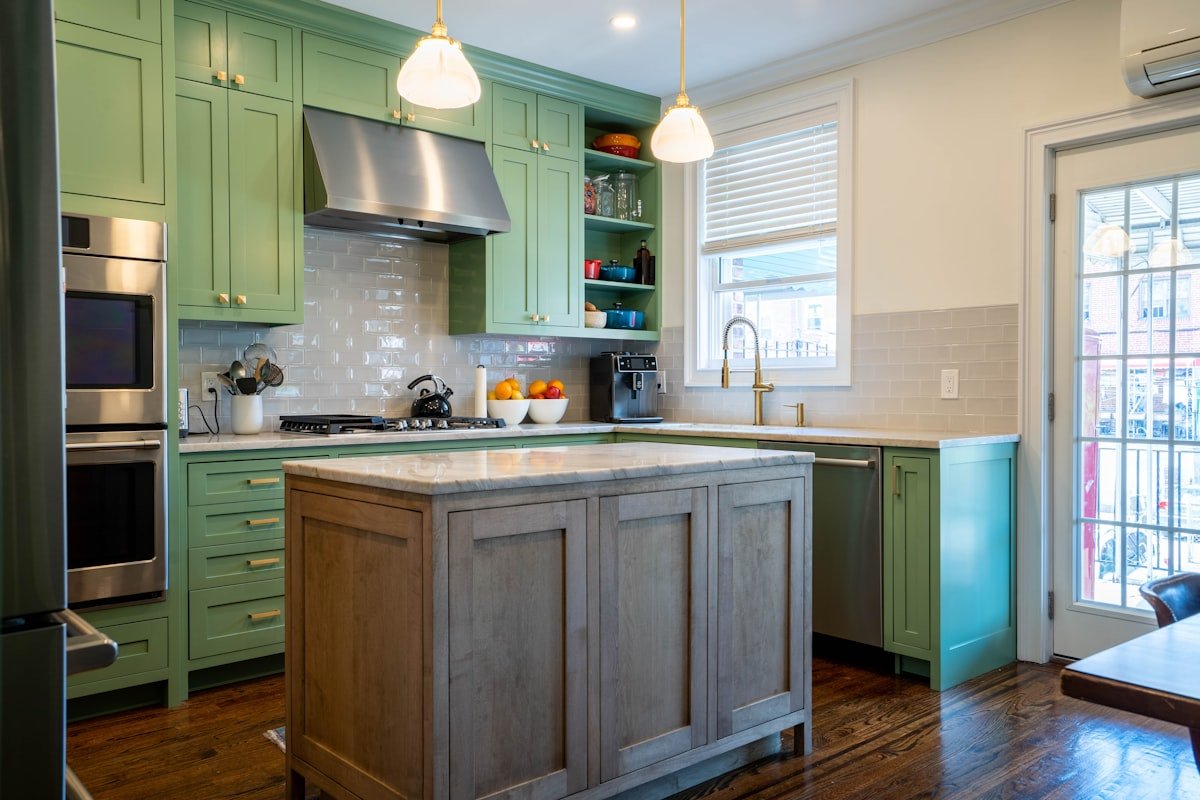
A backsplash sits near eye level, so a busy pattern can dominate a compact kitchen. If the countertop already has strong veining or the cabinets carry a saturated color, a simpler backsplash often gives the room more breathing room.
Large-format tile, simple stone, quiet subway tile, or a low-contrast pattern can reduce the number of visible seams. Grout matters too: dark grout with light tile creates a strong grid, while grout closer to the tile color makes the surface read more continuously.
Use Open Shelving Selectively
Open shelves can make a wall feel lighter because there is less cabinet mass, but only if the shelves are edited. A shelf packed with food packaging, appliances, decor, and dishes can look busier than a closed cabinet.
Use open storage for a controlled group of items that are attractive enough to see and used often enough to stay clean: everyday glasses, dishes, a few bowls, cookbooks, or a plant suited to the available light. One or two shelves may be enough. You do not need to remove an entire wall of upper cabinets to get a lighter look.
Protect Floor Continuity and Clearances
The floor forms the visual base of the kitchen. Too many small rugs and transitions break it into separate zones. One properly sized runner can add softness and color while preserving continuity.
Function comes first. Check that cabinet doors, appliance doors, and drawers can open without catching the rug or nearby furniture. If you are planning a remodel, the NKBA planning guidelines provide useful reference dimensions for work aisles and appliance clearances; actual requirements can vary by layout and local code.
Choose Fewer, Better-Scaled Decor Pieces
Small kitchens do not need miniature decor everywhere. Several tiny objects can make the room feel more crowded than one or two larger, useful pieces.
- A cutting board that is used regularly
- A fruit bowl with enough scale for the counter
- One utensil crock instead of several small containers
- A small lamp on a safe, dry surface where appropriate
- One framed print in an eat-in area
- A single tray that groups daily essentials
Practical objects can provide much of the decoration in a working kitchen. Leave some cabinet tops, shelves, and counter sections intentionally empty so the eye has places to rest.
Common Small-Kitchen Decorating Mistakes
| Mistake | Better approach |
|---|---|
| Using many unrelated colors and finishes | Repeat a smaller palette and reserve contrast for a few accents. |
| Covering counters with decor | Protect working space and decorate mainly with useful objects. |
| Adding open shelves without editing the display | Keep visible items limited and frequently used. |
| Depending on one overhead light | Add task lighting over prep areas and brighten dark corners. |
| Using a busy backsplash beside a busy floor and counter | Let one large surface be the visual feature and quiet the others. |
| Choosing tiny decor because the room is small | Use fewer pieces with enough scale to look intentional. |
| Ignoring cabinet clutter | Improve storage so the counters can remain clearer. |
Frequently Asked Questions
What colors make a small kitchen look bigger?
Light and mid-tone colors can help, but continuity matters more than one specific shade. Warm white, cream, pale greige, muted sage, and soft blue-gray can all work when cabinets, walls, counters, and backsplash relate to one another.
Can a small kitchen have dark cabinets?
Yes. Dark cabinets can work when balanced with enough light and quieter surrounding surfaces. Dark lower cabinets with lighter uppers or walls often create depth without making the whole kitchen feel heavy.
Do open shelves make a kitchen feel larger?
They can make a wall feel lighter, but only when the shelves are not overcrowded. One or two edited shelves often work better than replacing every upper cabinet with open storage.
How can I make a rental kitchen feel bigger?
Focus on reversible changes: clear counters, organize cabinets, improve plug-in or removable lighting where appropriate, simplify open displays, use one cohesive runner, and repeat a small color palette through towels and accessories.
Does a mirror work in a small kitchen?
A mirror can reflect light or an attractive view, especially in an eat-in area, but it should be positioned away from constant cooking splashes and where it will not simply reflect clutter.
What is the fastest no-cost way to make a small kitchen feel more open?
Clear one uninterrupted section of countertop, remove rarely used appliances from view, simplify the refrigerator and open shelves, and reduce the number of unrelated objects visible at once.
Make the Kitchen Easier to Read
A small kitchen feels bigger when the room is visually easy to understand. Keep the largest surfaces cohesive, protect clear counters, improve the lighting, reduce unnecessary contrast, and let storage control the everyday clutter.
You do not have to remove personality. Use color, art, plants, hardware, and useful objects selectively so the kitchen still feels like your home. The square footage will not change, but the space can feel calmer, brighter, and much easier to live with.

Share Your Thoughts